Skip to content
Método CROWD

The Method

Understand theCROWDMethod

The CROWD method is a strategic framework built on the experience of someone who has led countless business and corporate transformations, drawing on both successful and unsuccessful cases, contextualized to each company's moment. Its purpose is to evaluate a range of opportunities within the business context, segmented into 5 fundamental pillars to drive scalable, sustainable growth. Each pillar represents a critical dimension that, when well developed, strengthens the others through strategic interdependencies.

Why CROWD?

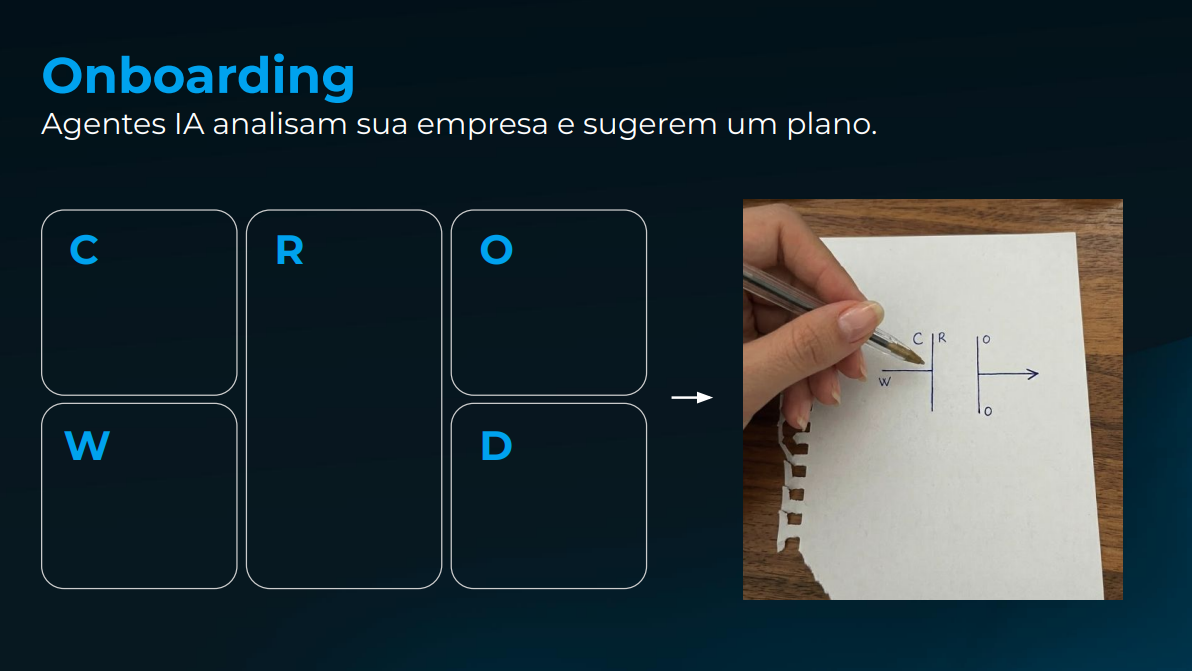
In a saturated, competitive market, companies that grow sustainably master five dimensions: building ecosystems (Community), continuous innovation (Reinvent), strategic focus (Outsourcing), financial efficiency (Wealth) and scalable distribution (Distribution). The CROWD method systematically evaluates each of these areas.

CROWD Method onboarding: AI agents analyze the company and suggest a plan, with the five pillars sketched by hand

How it works

In just a few minutes you answer a survey per pillar, and receive a professional strategic diagnosis.

  1. Choose a pillar

    Select one of the 5 pillars of the CROWD method to start the assessment.

  2. Answer the assessment

    12 strategic questions to map your business's maturity level.

  3. Get your diagnosis

    Our specialized AI generates a personalized diagnosis with opportunities and an action plan.

Community & Ecosystem

Community

How do I generate value through a community?

The Community pillar assesses how your ecosystem is structured to generate organic growth, reducing Customer Acquisition Cost (CAC) through referrals, partnerships and active communities.

Key metric
CAC Reduction

Areas assessed — 12 questions

  • Does your company have a structured referral program with incentives for customers?
  • Do you have active partnerships with influencers or opinion leaders in your industry?
  • Is there an organized online community (group, forum, platform) around your product/service?
  • Are satisfied customers systematically engaged and invited to become active brand promoters?
  • Do you run co-marketing or co-selling with strategic partners on a recurring basis?
  • Is there a formally structured partner program with clear SLAs and incentives?

+ 6 additional questions in the full assessment

Why this pillar matters

In saturated markets, organic growth through an ecosystem reduces CAC and builds defensibility. Companies that master Community create armies of promoters who sell for them, turning customers into a distribution channel.

Innovation & Technology

Reinvent

How do I use technology to reinvent the way I deliver value?

The Reinvent pillar assesses the degree of adoption of technology, automation and AI, measuring the ability to continuously innovate and accelerate value delivery using DORA metrics.

Key metric
Technology Efficiency

Areas assessed — 12 questions

  • Do you systematically monitor engineering metrics (DORA: lead time, deployment frequency, MTTR)?
  • Have critical, repetitive processes in your operation already been automated with technology?
  • Does your company run A/B tests systematically and frequently to validate product and marketing hypotheses?
  • Is generative AI already integrated into relevant operational workflows of the business?
  • Do you have a structured process-automation roadmap with clear prioritization and owners?
  • Is your product release frequency sufficient to meet market demand?

+ 6 additional questions in the full assessment

Why this pillar matters

Speed of adaptation determines survival. Companies that integrate AI, automation and DORA metrics deliver value faster, with fewer bugs and greater operational capacity. Reinvent is the efficiency engine that funds growth.

Strategic Outsourcing

Outsourcing

What can I outsource to operate with more agility?

The Outsourcing pillar assesses the clarity around what is "core" vs. non-core and the maturity of external partner management to scale without compromising quality or security.

Key metric
Core Business Focus

Areas assessed — 12 questions

  • Do you have formal, documented clarity on which functions are "core" vs. non-core in your business?
  • Are support functions (IT, accounting, legal, HR) managed with SLAs by specialized partners?
  • Do you have formal, measurable SLAs (Service Level Agreements) with all critical vendors?
  • Is there a formal, recurring process to evaluate the quality and performance of external vendors?
  • Can your operation scale quickly during demand spikes without needing to hire internally?
  • Are brand, data and reputation risks mapped and controlled in your outsourcing strategy?

+ 6 additional questions in the full assessment

Why this pillar matters

Focus is scarce. Companies that clearly identify what ONLY they can do and delegate the rest to specialists scale without losing quality. Strategic outsourcing frees up resources for innovation and competitive differentiation.

Financial Health & Value

Wealth

How do I generate wealth for everyone involved in the chain?

The Wealth pillar assesses financial health, the efficiency of value generation per employee (RPE), and the ability to fund sustainable growth with predictability.

Key metric
Revenue Per Employee (RPE)

Areas assessed — 12 questions

  • Do you know your company's current Revenue Per Employee (RPE) and have a clear target to increase it?
  • Does your company have reliable cash-flow predictability for the next 6-12 months?
  • Is the share of recurring revenue (ARR/MRR) relative to total revenue above 60%?
  • Is customer LTV (Lifetime Value) more than 3x CAC (Customer Acquisition Cost)?
  • Do you have clear, transparent incentive mechanisms for the team (profit sharing, equity, bonuses)?
  • Has the company already explored or used alternative funding sources (CVC, crowdfunding, strategic partnerships)?

+ 6 additional questions in the full assessment

Why this pillar matters

Growth without financial efficiency is unsustainable. RPE (Revenue Per Employee) measures how well you convert human resources into value. Companies with high RPE have room to invest, fail fast and scale predictably.

Distribution & Scale

Distribution

How do I distribute and scale my product efficiently?

The Distribution pillar assesses the ability to distribute at scale with efficiency and brand impact, measuring MER (Marketing Efficiency Ratio) and the sophistication of the omnichannel strategy.

Key metric
Scale Increase

Areas assessed — 12 questions

  • Are you clear on which acquisition channels generate the best ROI, and do you allocate budget proportionally?
  • Does your company regularly measure MER (Marketing Efficiency Ratio) or an equivalent metric?
  • Do you use multi-touch attribution models to understand the customer's full journey to conversion?
  • Does your organic content strategy generate qualified leads consistently and measurably?
  • Does your company have a robust first-party data strategy with proper consent and privacy governance?
  • Do you actively test new distribution channels (Creator Economy, new platforms, new formats)?

+ 6 additional questions in the full assessment

Why this pillar matters

A great product without effective distribution is invisible. MER (Marketing Efficiency Ratio) measures how much incremental revenue each dollar invested in marketing returns. Distribution is about reaching the right customer, at the right time, with the right message, at optimized cost.

Strategic Interdependencies

The CROWD method doesn't evaluate pillars in isolation. Each dimension influences and strengthens the others:

CROWD

Ready to evaluate your company?

Start your free assessment and discover strategic opportunities in each pillar.

Start Assessment